
Understanding PGT-A Testing: What It Is and Why it Matters in IVF
- Category: Education, Fertility Tips + Tricks
- Written By: Ashley Tiegs, MD

If you are going through fertility treatment, every step toward achieving a healthy pregnancy is critical. One of the technologies supporting this process is Preimplantation Genetic Testing for Aneuploidy (PGT-A), which has allowed for improved outcomes in fertility treatment involving in vitro fertilization (IVF). But what is PGT-A and why is it important?
What is PGT-A testing?
Preimplantation Genetic Testing for Aneuploidy (PGT-A) is a genetic screening process detecting the number of whole chromosomes in an embryo.
What are common misconceptions about PGT-A testing?
As PGT-A only screens for chromosome number abnormalities (aneuploidy), it does not screen for specific gene mutations. Your doctor will offer testing for specific gene mutations prior to proceeding with IVF, which will indicate whether more specialized testing for a specific genetic mutation is indicated (e.g., BRCA1 or 2, cystic fibrosis, sickle cell disease, etc.). This more specialized testing, Preimplantation Genetic Testing for Monogenetic diseases (PGT-M), can then be added to your plan.
A common misconception is that PGT-A guarantees a healthy baby. PGT-A reduces the risk of chromosomal abnormalities but cannot guarantee a healthy baby.
PGT-A also does not screen for all genetic conditions, developmental issues, or birth defects unrelated to chromosome number.
Why is detecting the number of chromosomes in an embryo important?
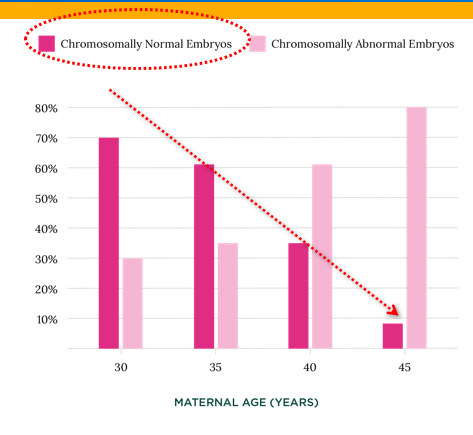
Humans should have 46 chromosomes, however, very commonly, embryos are made with extra or missing chromosomes. The eggs are responsible for ensuring the correct number of chromosomes enter each cell. As women age, the eggs divide up the chromosomes increasingly incorrectly, resulting in a higher proportion of chromosomally abnormal (i.e., aneuploid) embryos made. Incorrect chromosome number in the embryo is the primary cause of miscarriage (up to 70% of miscarriages) or negative pregnancy tests. Chromosome abnormalities in embryos occur even for young women(< 35 years of age) trying to conceive: up to 30% of embryos may be chromosomally abnormal (aneuploid).
If PGT-A normal (i.e., euploid), the embryo has the ability to cause a pregnancy. If PGT-A abnormal (i.e., aneuploid), the embryo will result in either: a negative pregnancy test, miscarriage, or child with chromosome abnormality (i.e., Down Syndrome, Edwards Syndrome, Patau Syndrome).
How is PGT-A testing done?
From the part of the embryo that becomes the placenta, a few cells are removed and sent for chromosome testing. The cells rapidly regenerate from where they originated, and the embryo is immediately frozen. The genetic testing results return in approximately 2 weeks.
Available non-selection study data demonstrates that removing these cells does not impact the embryo’s ability to implant or become a baby, so this procedure is considered very safe.
Why is PGT-A Important?
Simply put, not all embryos are able to progress to a baby. PGT-A is a selection tool that allows scientists to identify embryos that have the highest chance of making a baby.
- Reduces risk of miscarriage
- Faster time to pregnancy
- Reduces risk of chromosome abnormalities
- Allows for single embryo transfer:
- Singleton gestations are associated with decreased obstetric complications and significantly improved neonatal outcomes as compared to twin gestations.
- Provides reassurance
- Although routine antepartum testing is still recommended, PGT-A is highly accurate (>95% clinically) and provides peace of mind for many patients.
Figure below: Use of IVF + PGT-A with Single Embryo Transfer (Autologous Oocytes)
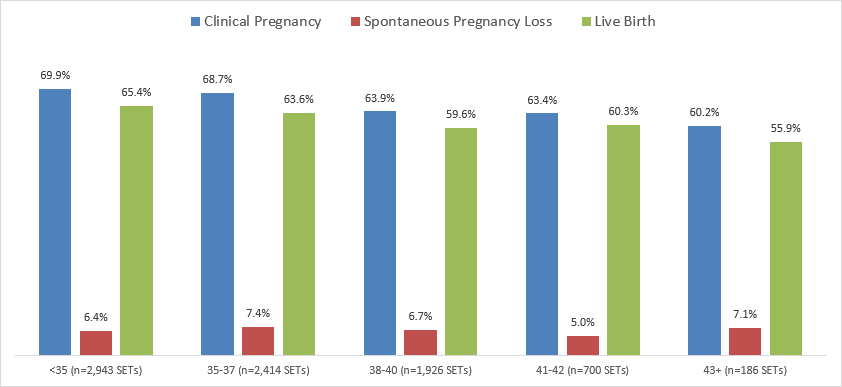
Source: 2007-2023 SART data and CCRM Network internal data 2007-2023.
Link to SART CSR:
"A comparison of clinic success rates may not be personally applicable because patient medical characteristics, treatment approaches, and entry criteria for ART may vary from clinic to clinic."
Important Limitations to Note:
IVF labs and PGT-A genetics labs are different. When choosing to proceed with PGT-A as part of your IVF process, the quality of the embryology lab and the accuracy of the PGT-A assay are exceedingly important. At ACRM/ CCRM, we are equipped with a state-of-the-art embryology lab. Quality control and assurance are performed daily and at every level of detail within the laboratory. Our large laboratory network with world-class technology and staff provide the foundation for cutting edge research, keeping CCRM laboratories on the cutting edge of reproductive science. Additionally, we are fortunate to have access to an exceedingly accurate PGT-A assay to provide our patients with the best possible care and outcomes. However, a comparison of clinic success rates may not be personally applicable because patient medical characteristics, treatment approaches, and entry criteria for ART may vary from clinic to clinic.